

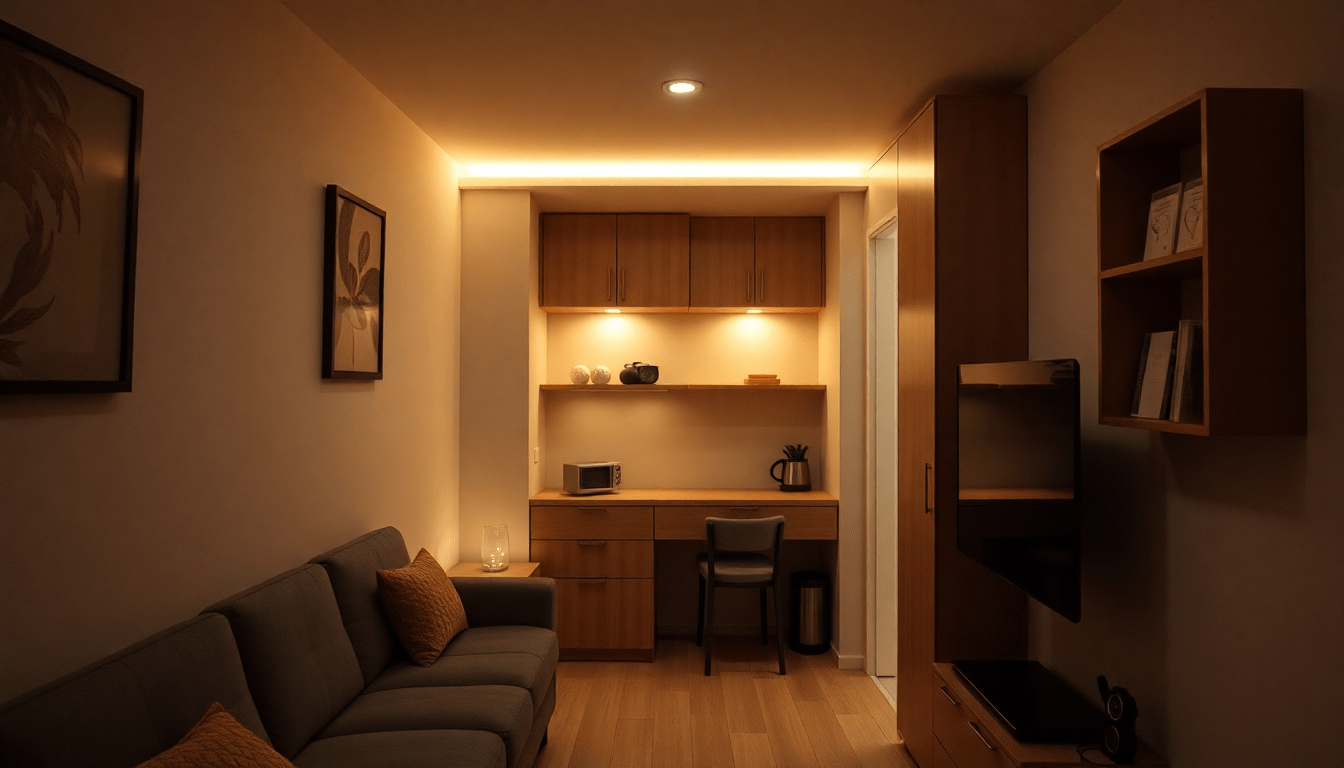
Compact living, big lighting impact: modular ambient layers, daylight-mimicking LEDs, and adaptive smart controls for micro-apartments.
Introduction: Rethinking Lighting in Micro-Units
In dense urban homes, every square foot matters. Smart lighting design transforms limited ceiling height and window exposure into a coherent mood, better task performance, and lower energy use. This guide explores how modular ambient layers, daylight-mimicking LEDs, and adaptive smart controls work together to make micro-apartments feel larger, more comfortable, and incredibly functional.
Understanding Micro-Apartment Lighting Architecture
Micro-apartment lighting must fuse function, mood, and efficiency. The architecture centers on layered illumination that can be scaled to tiny footprints, reconfigured over time, and controlled with precision.
Modular Ambient Layers: Layering Light for Small Spaces
- Ambient base layer: a soft, even glow that defines the space without glare or harsh shadows.
- Task layer: targeted illumination for desks, countertops, and work zones to support productivity.
- Accent layer: adjustable highlights for artwork, textures, and architectural features to create depth.
- Hidden or secondary layer: cove, under-cabinet, or backlit panels that add dimension with minimal ceiling clutter.
Daylight-Mimicking LEDs: Harnessing Circadian-Friendly Illumination
LEDs that reproduce natural daylight and adapt through the day support circadian comfort and perceived spaciousness. Key choices include color temperature range, color fidelity, and smooth dimming.
- Color temperature: 2700K–6500K to mirror sunrise to sunset transitions.
- Tunable white with CRI > 90 for accurate color rendering in small rooms.
- Glare control and flicker-free dimming for comfortable long-term use.
- Daylight-aware scenes that respond to window exposure and weather patterns.
Adaptive Smart Controls: Personalization, Scheduling, and Energy Savings
Smart controls turn static lighting into a responsive system that aligns with routines, daylight, and occupancy, delivering comfort and efficiency.
- Occupancy sensors reduce energy use when spaces are unused.
- Daylight sensors adapt artificial light to the available natural light.
- Scenes and routines automate color and brightness for morning, work, and evening.
- Voice control and hub integration enable seamless operation across devices and platforms.
Design Scenarios: Micro-Unit, Studio Loft, and Co-Living Space
Different micro-dwelling layouts demand tailored layering to maximize impact without clutter.
- Micro-unit: compact fixtures, under-cabinet strips, and a wall-wash to visually expand the space.
- Studio loft: mezzanine lighting integrated with smart dimming to separate zones without sacrificing cohesion.
- Co-living: modular fixtures that can reconfigure for privacy zones, shared zones, and flexible furniture layouts.
Implementation Guide: From Concept to Built Environment
- Audit natural light, glare, ceiling height, and window orientation to inform layer placement.
- Define light layers that cover surfaces evenly without visual clutter or hotspots.
- Choose compact fixtures with modular components and robust thermal management for long life.
- Budget wiring and power for future smart controls and firmware updates.
- Integrate controls early with a centralized hub and a reusable scenes library.
- Calibrate color and brightness to ensure consistent performance across fixtures.
- Plan maintenance access, especially for hidden layers and ceiling-mounted drivers.
- Incorporate dimming profiles and blackout options for privacy and sleep quality.
- Document wiring diagrams and control schemas for future upgrades.
- Test interoperability across devices and platforms before occupant handover.
- Develop a commissioning checklist to verify luminance, color, and response times.
- Establish a budget and schedule for periodic recalibration and firmware updates.
Choosing Fixtures and Components
- Recessed linear profiles and slim panels for unobtrusive ambient light that preserves ceiling height.
- Modular pendants and wall washers to create focal accents without crowding the ceiling plane.
- Tunable LEDs with high CRI, wide CCT ranges, and stable drivers for longevity.
- Smart bulbs and driverless fixtures with local control and reliable remote access.
- Low-profile diffusers and anti-glare louvers to maintain visual comfort in small rooms.
- Energy-efficient drivers and heat management designed for modular, stacked configurations.
Sustainability Considerations: Longevity and Upgrades
Modularity enables easy upgrades, reduces waste, and supports evolving standards. Prioritize fixtures with replaceable modules, modular drivers, and long lifespans to future-proof a micro unit.
- Long-life LEDs and replaceable components minimize disposal impact.
- Standardized connectors and plug-and-play parts simplify upgrades.
- Driverless or smart-ready architectures reduce refitting needs during renovations.
Maintenance and Future-Proofing
Proactive maintenance preserves performance and comfort. Schedule regular checks of connections, dimming curves, and firmware, while keeping power budgets flexible for future smart-home ecosystems.
Case Study Sketch: A Real-World Micro-Unit Implementation
Consider a 22–28 square-meter micro-unit with south-facing windows. A layered approach uses:
- Base ambient with a slim ceiling panel and wall washers that visually expand the room.
- Task lighting at a compact desk with a tunable color temperature for focus and reading.
- Accent lighting highlighting a piece of art and architectural texture.
- An adaptive smart hub pairing occupancy sensors with daylight-aware scenes to maintain comfort through seasonal changes.
The outcome is a space that feels larger, functions better, and consumes less energy, thanks to a coordinated lighting strategy rather than isolated fixtures.
Cost Considerations, ROI, and Budgeting
While upfront costs for modular, tunable, and smart lighting may be higher, long-term savings come from energy efficiency, extended fixture lifespans, and reduced renovation needs. A clear ROI comes from:
- Lower energy bills due to occupancy and daylight sensing.
- Less waste via modular upgrades rather than full replacements.
- Improved occupant productivity and well-being through circadian-friendly lighting.
The Future of Micro-Lighting: Trends to Watch in 2026
- AI-assisted lighting scenes that learn routines and optimize power usage.
- Human-centric lighting that adapts to activities, moods, and sleep cycles.
- Wireless standards and interoperable ecosystems that simplify integration.
- Transparent materials and minimalist fixtures that maximize perceived space.
- Flexible, reconfigurable fixtures designed for evolving co-living formats.
Conclusion: Light as a Core Amenity in Micro-Urban Living
In micro-apartments, light is more than illumination—it’s a design tool that shapes space, mood, and efficiency. By layering ambient light, mimicking daylight, and enabling adaptive smart controls, small homes achieve big impact with calm, coherent aesthetics.
Visit XENTAR for more lighting, decor & furniture curated for modern homes and creative spaces.
Share:
Adaptive Ambient Lighting for Small-Scale Homes: Modular, Biophilic Systems with Smart, Eco-Efficient Controls
Three-Dimensional Ambient Lighting for Tiny Homes: Layered Modular Systems with Biophilic Accents and Personalizable Smart Controls